2026
Consumer
Trends report
How TV Shapes Modern Behavior
The way consumers experience TV has fundamentally changed.1
They watch everywhere – on the couch, on their phones, on the go – while scrolling, shopping, and searching. TV is no longer a single device or a single moment. It’s a constant presence, woven into the way people discover brands, evaluate products or services, and buy.
At the same time, digital feeds have become crowded and chaotic. Attention is fragmented. Trust is harder to earn. And in the middle of that noise, consumers are turning to TV in ways that are more dynamic, more interactive, and more influential than ever before.
tvScientific by Pinterest's first-ever 2026 Consumer Trends Report2 draws from 600+ consumers across four generations — Gen Z (18–27), Millennials (28–43), Gen X (44–59), and Baby Boomers (60–78) — to understand how they experience TV, discover new products, and make purchase decisions.
What emerges is not a story about TV alone, but about consumer behavior across screens: how streaming has become the default gateway to TV, how multi‑screen habits turn exposure into instant action, how trust is built across channels, and how interactive formats are reshaping expectations.
These insights reveal the real reason Performance TV is the #1 channel for media spend3: because consumers are already using TV as a full‑funnel, action‑driving channel.

Gen Z
Millennials

Gen X
Boomers
TV’s credibility edge
TV remains one of the most trusted screens in consumers’ lives. It’s familiar, immersive, and grounded in decades of viewer confidence.
As viewing has expanded beyond traditional cable into streaming apps, connected devices, and live digital environments, TV has retained something other media channels struggle to replicate: credibility.
How consumers watch TV today
A mix of streaming and live TV
Only streaming apps (i.e., Netflix, Prime Video)
Mostly streaming apps
Mostly live TV
Only live TV
subscribe to 3+ streaming services
subscribe to 4+ streaming services
subscribe to 5+ streaming services
Streaming has become the center of modern TV consumption, reshaping how audiences of all ages watch. While younger audiences have led this shift, it’s now a familiar behavior across every generation. Today, 92% of Gen Z and 90% of Millennials watch TV through streaming apps, and older audiences have crossed the threshold as well: Gen X sits at 83%, and even Baby Boomers, long considered cable loyalists, now reach 61%.
The one exception that still draws audiences to live TV is sports or live events, and even that has shifted. 65% of consumers now watch sports and live events through streaming platforms, not cable. Even TV’s strongest remaining anchor, live events, has now moved decisively into streaming.
And consumers aren’t just streaming more — they’re subscribing across more services.
Households are stacking multiple services, signaling that streaming is no longer a single‑platform behavior but a full ecosystem.
While Gen Z and Millennials lead in volume, with over 76% having 3+ services, the most striking shift is among Baby Boomers: 52% now subscribe to three or more services. What was once a younger‑audience behavior is now mainstream.
Top 5 streaming apps





78%
63%
55%
46%
40%
Netflix and Hulu dominate streaming, but the landscape is otherwise increasingly fragmented across multiple platforms. As subscription stacks grow, consumers are making tradeoffs, and one of the clearest outcomes is the rise of ad-supported tiers. With cost top-of-mind, viewers are increasingly choosing options that balance price with access.
The rise of ad‑supported viewing
choose ad‑supported TV
choose ad‑supported TV because it’s cheaper
simply don’t mind ads on TV
Ad-supported viewing has become a mainstream choice, mainly driven by cost-sensitive audiences seeking value without sacrificing content.
But the generational split reveals deeper behavioral patterns: 74% of Baby Boomers have ad-supported tiers in their streaming mix, compared to 43% of Gen Z. It’s a notable twist: Gen Z is the most willing to pay for ad-free viewing, underscoring how much they value control over their media experience.
pay more attention to ads on TV than on their phone
say TV ads feel more premium than ads on Instagram, Facebook, TikTok, and X.
say TV ads feel less intrusive than ads on Instagram, Facebook, TikTok, and X.
say TV ads feel more credible than ads on Instagram, Facebook, TikTok, and X.
TV wins on every measure that matters: attention, quality perception, and trust. And this is consistent across generations. This credibility only strengthens as consumers encounter brands across multiple channels.
say seeing a brand on TV makes them trust it more
say seeing a brand on TV makes them trust it more when they see it again on social
say seeing a brand on social first makes the TV ad feel more legitimate
This interplay between platforms is powerful: When consumers encounter a brand on both social and TV, each touchpoint amplifies the other, turning quick impressions into lasting trust.
Gen Z is the most trust‑responsive generation, countering the stereotype that young audiences are immune to advertising. In fact, 57% of Gen Z say that seeing a brand on TV makes it feel more legitimate after seeing it on social media, compared to only 34% of Baby Boomers.
And this trust response connects directly to where discovery begins.

discover new products on social
discover new products on search
discover new products on TV
Other channels included in the survey not shown included in-store and AI search.
Discovery is a three-way split, with no single channel dominating the top of the funnel. Together, these behaviors show a clear pattern: social and search spark discovery, while TV strengthens credibility and helps those early impressions take hold.
Social media is especially important for Gen Z, with 43% discovering new products there. However, it’s clear that across audiences, these channels work together. Discovery often starts on social or search, while TV provides a trusted environment that helps those impressions stick.
Consumers aren’t choosing one channel over another, they’re navigating all of them in sequence. Streaming drives how they watch, social and search drive what they discover, and TV strengthens the impressions that matter most.
As a result, TV stands out as a trusted, high-attention environment in a fragmented media landscape, helping amplify the impact of other media channels.
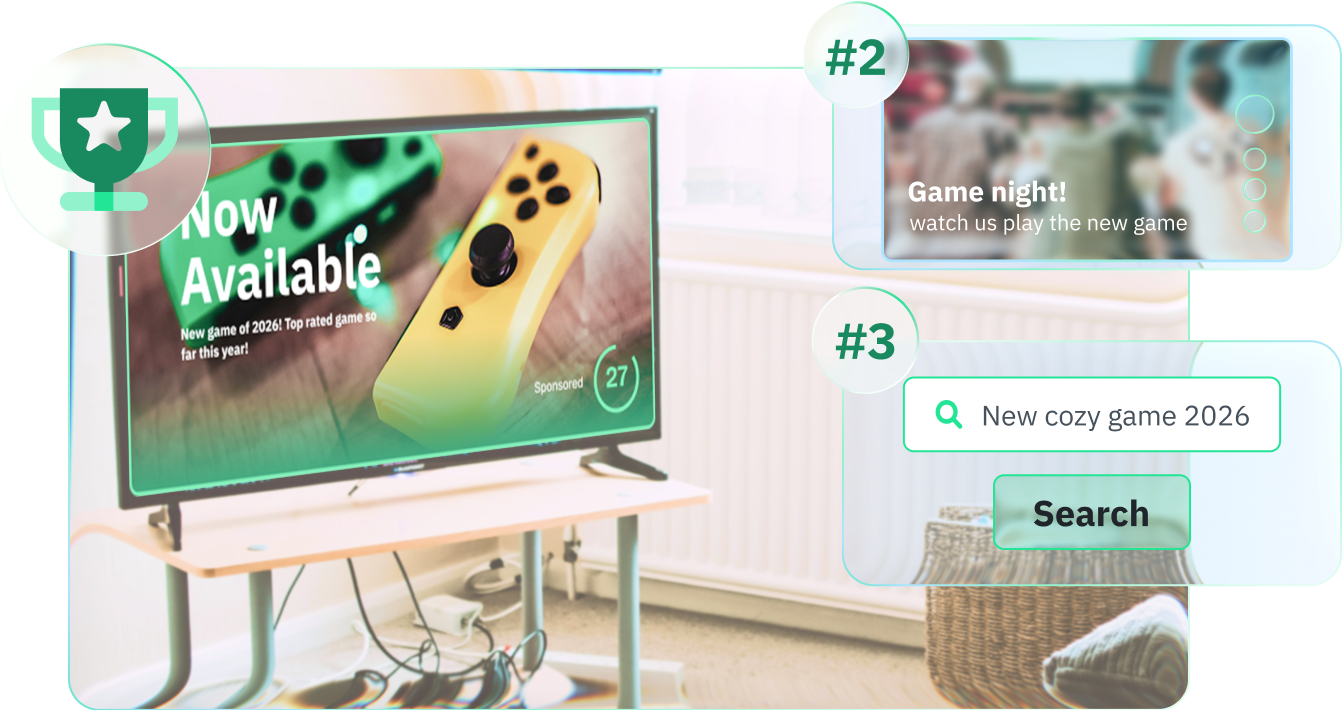
Welcome to the dual‑screen reality
Watching TV is no longer a single‑screen experience. It’s ambient, mobile, and deeply intertwined with how people shop, search, and communicate. This is where Performance TV can become uniquely powerful: exposure on the biggest screen triggers action on the smallest.
Where people watch TV
Smart TVs may dominate, but mobile’s rise shows that viewing has become a fluid, multi‑device behavior.
While smart TVs dominate across all generations, mobile plays an outsized role for younger audiences. 62% of Gen Z watch on their phones, compared to 60% of Baby Boomers who remain anchored to the smart TV screen. These differences shape how each generation engages with ads: younger viewers are more fluid, shifting between screens, while older viewers remain more focused.

The dual-screen reality
It’s clear that dual‑screening is now the norm, turning TV viewing into an always‑connected, action‑ready moment.
And generational patterns reveal distinct audience behaviors. Gen Z is the most active and distracted: 91% scroll social, 73% game, and 93% text while watching TV. Millennials are the most commerce‑driven, with 78% shopping online while watching TV. Gen X is the most ad‑responsive, with 74% looking up products they see in ads. Boomers are the most focused audience, with only 48% scrolling or shopping while watching.

Gen Z
Millennials

Gen X
Boomers
These behaviors matter because they turn TV exposure into immediate action. When a brand appears on TV, consumers search, compare, read reviews, and visit websites in real time.
Performance TV connects these behaviors into measurable outcomes.
“Working with tvScientific completely changed how we measure TV success. The Spike Lift report proved people were taking action, we saw a 7x spike in site traffic within minutes and a 13% lift in purchases overall. We reached over 4 million households and generated 15 million impressions.”

Neal Didonna
Vice President of eCommerce, MTN OPS4
TV is the commerce engine in the modern funnel
TV doesn’t just build brand awareness. It drives action, confidence, and conversion across every generation.
The data shows a clear pattern: when people see a brand on TV, they move.

of consumers have made a purchase after seeing a TV ad
Top actions after seeing a TV ad
Searched for the brand
Visited the website
Looked up reviews
TV isn’t just memorable, it’s a direct driver of purchase behavior. And the immediate response to TV ads is overwhelmingly action-oriented: search, site visits, and research.
The path to purchase varies by generation. Most consumers go straight to search, with 59% using Google or another search engine as their first stop. Younger audiences are more likely to jump to social, with 21% of Gen Z going straight to social, while 0% of Baby Boomers follow suit.
And cross‑channel reinforcement only amplifies this impact. When consumers have already seen a brand on social or in search, TV accelerates conversion.

of consumers say they are more likely to buy if they have seen the brand on social before seeing it on TV
say they are more likely to buy if they have seen the brand in search before seeing it on TV
say TV ads help them feel more confident before buying
TV doesn’t just work in isolation. It works best as part of a coordinated, multi-channel strategy.
However, this confidence effect isn’t uniform across generations, and the gap is telling. 60% of Gen X say TV ads help them feel more confident before buying, the highest of any generation, while only 44% of Gen Z report the same, reflecting their tendency to seek additional validation through social proof before committing.
Confidence matters most when the stakes are highest, and carries into major shopping moments, where consumer attention spikes and competition intensifies.
Top 5 shopping moments consumers pay attention to the most:
Black Friday/
Cyber Monday
65%
Holiday
Season
56%
Prime
Day
35%
Fourth
of July
23%
Back to
School
22%
*Followed by Memorial Day, Labor Day, Fall football season, President’s Day, and New Years.
These peak shopping moments represent the highest‑stakes windows for influencing consumer decisions.
The pattern holds at the category level, too. Black Friday and Cyber Monday dominate as the top sales moment – from electronics and apparel to home, beauty, travel, automotive, gaming, and subscriptions. The holiday season consistently ranks second, rising to the top spot only for gift‑driven categories. Prime Day holds third place in most categories, with one notable exception: travel, where the Fourth of July takes that spot instead.
TV’s role in driving action doesn’t stop at awareness — it runs all the way through to the sale. Its impact is strongest when paired with social and search, creating a sequence of touchpoints that move consumers from awareness to action with greater confidence.
“Every channel started performing better. Search picked up. Social picked up. Even organic traffic moved. And we could tie it all back to that CTV lift.”

Bryan Karas
CEO of Playbook Media5
Where creative becomes conversion
Not all TV ads are created equal. Consumers are clear about what they remember, what they trust, and what makes them act. The right creative turns TV from a passive experience into a performance driver.
What people remember
What drives action
Humor dominates recall, proving that entertainment value is still the strongest memory trigger. Clarity and simplicity outperform everything else when it comes to driving action. And streaming apps are now the premier advertising environment, with 36% of consumers saying that ads perform the best in streaming apps over cable TV, live streaming, and free ad-supported streaming.
However, environmental preference breaks along generational lines. Baby Boomers stand apart as the only generation where cable TV ranks as the top-performing environment, at 32%. Gen Z, Millennials, and Gen X all point to streaming apps as the environment where TV ads perform best, consistent with where those audiences spend the majority of their viewing time.
The implication for advertisers is straightforward: creative and placement are inseparable. The most effective TV strategy matches the right message to the right format, delivered in the environment where each audience is most engaged and most receptive.
“We saw a 354% increase in 2023 YOY, a 1100% YoY increase in 2024, and another 62% lift already this year so far which is well above the normal program averages. tvScientific has also shot up in the ranks from 16th to a top 5 publisher this year. We look forward to continuing the partnership.”

Brian Robbins
Head of Affiliate Marketing, LG6
TV’s next era is shoppable, personalized, and creator‑led
TV is evolving from a one-way medium into an interactive ecosystem where viewers can click, shop, explore, and buy in real time. Younger generations are leading the shift, but the appetite for interactivity is growing across the board.
Interest in interactive formats
This interest in interactive formats shows that viewers increasingly expect TV to behave like a digital platform.
However, the generational differences are stark. 53% of Gen Z want personalized ads, compared to 20% of Baby Boomers. 44% of Gen Z and Millennials want live shopping experiences, compared to 11% of Baby Boomers. Shoppable pause ads appeal to 45% of Gen Z but only 11% of Baby Boomers.
Creator-led advertising is also rising, with 29% of consumers now paying attention to creator-led TV ads and 40% of Gen Z ranking them as their top advertising format. It’s clear that these creator-driven formats are becoming a meaningful bridge between social behavior and TV engagement.
Interactive formats are pushing TV into its next phase. One where attention becomes action instantly, and where Performance TV becomes a fully shoppable, measurable environment.



The consumer truth behind TV’s rise
Consumers have rewritten the rules of TV, and the brands that win will be the ones that follow their lead.
TV is now a high-intent, high-trust environment that drives immediate action, especially when paired with social and search. It’s where fragmented attention converges, where credibility is built, and where decisions accelerate.
But the story doesn’t stop at trust.
It’s about how people watch:
streaming‑first, multi‑device, and constantly in motion.
It’s about how people behave:
discovering on social media, validating on TV, and acting across screens in seconds.
And it’s about what they expect:
creative that entertains, informs, personalizes, and increasingly invites them to click, shop, or explore in real time.
Performance TV works because it mirrors how people behave today: fluid, multi-screen, discovery-driven, and ready to act. It’s no longer a legacy channel or a top-of-funnel tactic. It’s a measurable, full-funnel engine that connects attention to action, trust to conversion, and creative to outcomes.
For marketers, the opportunity is clear: align with how consumers already use TV, and you unlock a channel built for performance.
1Source: Deloitte Insights, “Changing TV-watching mindset,” October 26, 2025.
2Source: tvScientific by Pinterest 2026 Consumer Trends Report, United States, February 2026, n=600 people that watch tv – all data in this report except where a different source is cited.
3Source: tvScientific by Pinterest 2026 State of Performance TV Report, United States, January 2026.
4Source: tvScientific by Pinterest Internal Data, MNT OPS Case Study, United States, December 2025.
5Source: tvScientific by Pinterest Internal Data, Playbook Media Case Study, United States, May 2025.
6Source: tvScientific by Pinterest Internal Data, LG Case Study, United States, October 2025.