For years, television was boxed into a narrow role inside the media plan. It was the awareness driver. The storytelling channel. The “top-funnel” investment that supposedly sat far away from performance marketing.
At the same time, digital performance evolved into a hyper-optimized ecosystem built around clicks, last-touch attribution, and platform-reported return on ad spend.
Those two worlds used to operate separately.
They don’t anymore.
Connected TV (CTV) is bought programmatically, optimized toward declared outcomes, and measured using deterministic identity. When CTV is integrated properly into a modern performance stack, something becomes very clear: it doesn’t just drive isolated conversions. It systematically improves how other channels perform.
That cross-channel amplification is what we call the Halo Effect.
And today, it’s measurable.
What is the halo effect?
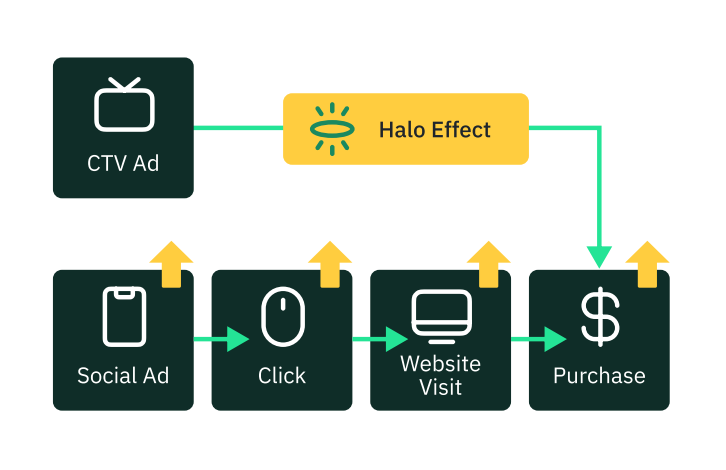
The Halo Effect is the incremental lift in downstream conversion behavior that occurs after a user is exposed to a CTV ad.
It shows up when users who have seen your brand on TV later convert at higher rates through paid search, paid social, direct visits, or organic traffic compared to users who were never exposed.
The critical point is that CTV is not designed to generate immediate clicks. Its value is not confined to a single touchpoint. Instead, it changes the probability of future behavior.
When someone sees your brand in a high-attention, full-screen environment, familiarity increases. Familiarity reduces friction. Reduced friction increases the likelihood of action the next time that user encounters your brand elsewhere.
That behavioral shift is the halo.
Why CTV creates such a powerful halo
CTV sits at the intersection of emotional storytelling and digital precision. It reaches people when they’re relaxed, attentive, and open, and that changes how they respond everywhere else.
CTV generates new demand
Search captures intent, social captures engagement, and TV captures storytelling and scale. It reaches people before they begin researching, expanding the pool of future converters.
CTV delivers full‑funnel attention
CTV ads are unskippable, immersive, and delivered in premium environments. They command attention in a way no other digital format can, building memory that fuels downstream action.
CTV primes users for lower‑funnel action
When someone encounters your brand again – on search, social, or elsewhere – the groundwork is already laid. Familiarity reduces friction. Confidence increases. Conversions rise.
The cross‑platform advantage
When CTV is added to a performance mix, its impact rarely shows up in isolation. Instead, it may increase the efficiency of downstream channels.1
Paid search may improve because users entering the auction already recognize your brand, which helps drive higher conversion rates and stronger cost‑per‑acquisition (CPA) efficiency. Paid socials may perform better because audiences are warmer and more receptive. Direct and organic traffic may also rise as viewers return intentionally after exposure.
CTV doesn’t redistribute credit across channels. It helps increase the baseline probability of conversion across the entire ecosystem.
That’s the cross-platform advantage: stronger performance not because one channel wins, but because the system works better together.
Measuring the halo effect with tvScientific
At tvScientific, we believe performance marketing should be transparent, measurable, and grounded in truth. That’s why we created the Halo Report: a clear, actionable way to quantify how CTV exposure influences conversions across your entire media mix.
The Halo Report compares conversion behavior between users who were exposed to your CTV ads and those who were not. This reveals how CTV increases conversion rates across paid search, paid social, and direct or organic traffic. As frequency increases, conversion efficiency improves, making the incremental lift unmistakable.
It brings clarity to what marketers have always sensed: TV moves people, and that movement shows up everywhere.
What the Halo Report reveals
The Halo Report reveals the incremental impact CTV exposure has on the rest of your performance ecosystem.
Instead of relying on last-click attribution, it shows how users who were exposed to CTV behave differently from those who were not. Specifically, it quantifies lift in conversion rates across paid search, paid social, direct, and organic channels.
It surfaces:
- Incremental conversion rate lift by channel
Changes in CPA and efficiency driven by prior exposure - How frequency impacts downstream performance
- Acceleration in time-to-conversion
Most importantly, it reframes performance from a single-channel lens to a system-level view. It shows not just whether CTV drove a click, but whether it increased the probability of conversion everywhere else.
When to use the Halo Report
The Halo Report is ideal for marketers who want to understand CTV’s influence beyond last‑click reporting, optimize blended ROAS, or quantify incremental lift across channels. It’s especially valuable for teams shifting toward holistic measurement and smarter media mix allocation.
Limitations to keep in mind
To ensure accurate measurement, the Halo Report requires assisted‑conversion data beyond last‑click reporting and statistical significance between exposed and unexposed groups. Lift is measured independently by channel, so aggregated lift requires channel‑level interpretation.
See the halo effect in action
The future of performance marketing is cross‑platform, measurable, and outcome‑driven, and CTV is leading that evolution. If you want to understand how TV exposure influences your entire media mix, the Halo Report gives you the clarity and confidence to optimize with purpose.
FAQ: Understanding the CTV Halo Effect
What is the CTV halo effect?
The CTV halo effect is the measurable lift that Connected TV creates across other marketing channels. When someone sees your brand on TV, they may be more likely to convert later through paid search, paid social, direct visits, or organic traffic.1 CTV builds familiarity and intent, and that influence carries through the entire customer journey.
How does CTV improve performance on other channels?
CTV exposure strengthens brand recall, which makes users more likely to engage when they encounter your brand again on search or social. The result may be higher conversion rates, stronger engagement, and more efficient spend across the media mix.
Why can’t last‑click attribution capture the halo effect?
Last‑click attribution only measures the final step before a conversion. It doesn’t account for the earlier moments that shaped the customer’s decision. CTV often plays that early, influential role, planting the seed long before the click happens. Measuring the halo effect requires assisted‑conversion data and a cross‑channel view.
How does tvScientific measure the halo effect?
tvScientific uses the Halo Report, which compares conversion behavior between users exposed to your CTV ads and those who were not. This reveals how CTV helps increase conversion rates across paid search, paid social, and direct or organic traffic, and how frequency impacts efficiency.
What are the limitations of halo measurement?
Halo measurement requires assisted‑conversion data and statistically significant exposed and unexposed groups. Lift is measured by channel, so interpreting total lift requires looking at each channel’s contribution individually.
Is the halo effect relevant for both B2B and B2C brands?
Yes. Whether the buying cycle is short or long, CTV strengthens brand familiarity and intent. That influence shows up across channels in both B2B and B2C environments.
Sources:
- tvScientific, “2026 Consumer Trends Report.” Internal data; report releasing April 2026




%20Need%20to%20Know.jpeg)