Spend five minutes at any tech conference or listen to any adtech earnings call, and you’ll drown in it: the jargon, the acronyms, the convoluted architecture diagrams. We’ve built an entire industry that wears complexity like a badge of honor. We celebrate the people who sound like they are speaking a different language because, the unspoken logic goes, if we can’t understand them, they must be geniuses.
But as legendary Apple designer Jony Ive perfectly captured: “It’s hard doing simple. It’s easy doing complex.”
Hiding behind a 'black box' or an impenetrable wall of tech-speak is often a mask for a lack of true understanding. True superior intelligence isn't the ability to build a labyrinth; it's the ability to draw a straight line through it.
The cult of complexity and the laziness of "more"
We have a fundamental misunderstanding in the tech ecosystem: we confuse "complicated" with "sophisticated."
Leonardo da Vinci famously observed that "simplicity is the ultimate sophistication." Yet, when a founder or a product manager pitches a solution with 40 different features, layered dashboards, and a proprietary data protocol that requires a Ph.D. to decipher, investors and buyers often nod along. Why? Because pushing back risks looking like you don't "get it."
Complexity is an excellent hiding place for ego and insecurity. If you can’t explain your product, your pricing model, or your attribution logic in a sentence that a normal human being can understand, you don’t actually understand it yourself.
Complexity is not an accident. It’s often a business model.
More insidiously, in industries like adtech, complexity is weaponized for profit. I’ve written before about the “black box” problem in advertising. Those black boxes aren't an accident of engineering; they are a business model. Obfuscation creates dependency (and high hidden margins).
But you see this same laziness internally every single day. One of my biggest pet peeves is receiving a complex executive briefing document that is literally pages long. The author usually thinks they are adding value by being "comprehensive." They aren't. What they are actually doing is pushing the cognitive load onto me. They are inflicting the hard work of synthesis onto the reader. It is not a value-add exercise to dump raw information onto someone's desk. True leadership means doing the agonizing work to simplify things before presenting them, rather than passing the buck.
First principles and the "True North"
So, how do you cut through the noise? You have to strip everything back to first principles.
In any context—whether you are building a software platform, launching a national marketing campaign, or just writing a memo—you have to stop and ask yourself one fundamental question: "What are we actually trying to accomplish here?"
That answer becomes your True North. Everything you do must be measured against it. If you don't establish that baseline, you inevitably start bolting on features, proxy metrics, and paragraphs that don't matter, just to feel productive.
The genius of subtraction
The pioneering aviator and writer Antoine de Saint-Exupéry put it best: "Perfection is achieved, not when there is nothing more to add, but when there is nothing left to take away."
Look at the companies that have actually redefined our world. They didn’t do it by piling on features; they did it through the ruthless, agonizing process of subtraction, guided by their True North.
Take Apple. When the iPhone launched, the smartphone market was dominated by devices that looked like miniature office desks—physical keyboards, styluses, endless buttons. Apple didn’t invent mobile computing. What they did was hide staggering technological complexity behind a single piece of glass. They made the impossibly complex universally accessible.
Or look at Google in the late 90s. The prevailing wisdom was that users wanted everything on the homepage. It was visual and cognitive clutter. Google showed up with a white screen and a single search bar. The backend engineering mapping the entire internet was infinitely more complex, but the user experience was incredibly simple.
The invisible sweat and the power of iteration
What people fail to realize is the sheer amount of invisible sweat required to deliver that kind of simplicity. You don't just wake up and build an intuitive product.
Steve Jobs understood this dynamic intimately: "Simple can be harder than complex: You have to work hard to get your thinking clean to make it simple. But it’s worth it in the end because once you get there, you can move mountains."
This brings to mind another crucial truth about building great things: the power of iteration. As Ive noted, “Products are only overnight successes in reverse. The iPod was not, the iPhone was not, the Watch was not.” Simplicity isn't an accident; it is the result of endless, agonizing iteration. To make an elegant product—or to write a brilliant one-page memo—the creator has to absorb all the friction so the user doesn't have to. You have to make the hard, controversial decisions about what to leave out. It’s the duck gliding effortlessly across the pond: calm on the surface, but paddling like hell underwater.
In my world—TV advertising—the industry spent decades trying to convince brands that TV was too complicated to measure like search or social. They created a web of probabilistic models, reach-and-frequency charts, and proxy metrics to justify ad spend without proving actual ROI. They lost sight of the True North: driving measurable business growth.
The "simple" approach was much harder to build. It required wiring up the fragmented television ecosystem directly to actual business outcomes—sales, downloads, revenue. Building the infrastructure to make CTV perform like search was incredibly complex. But the outcome for the user? Simple. Undeniable.
When the simplest answer is the right one
I’ve seen this dynamic play out firsthand with TV measurement. We have always known that TV is effective, but demonstrating its impact to performance advertisers—especially those conditioned to rely on last-click attribution—has been the challenge. You can’t click on a TV ad, so proving its value becomes more complex by default.
From a scientific perspective, there are many ways to solve this. If you want to go deep, there are established methodologies that have been used for decades: Shapley values, Markov chains, marketing mix modeling (MMM), incrementality testing, halo analysis. We’ve tested all of them at tvScientific by Pinterest.
And to be clear, those approaches are valid. They are rigorous and can prove causality. But they don’t always meet the “self-evident” threshold, and they don’t create that immediate reaction where someone sees the result and instantly understands it.
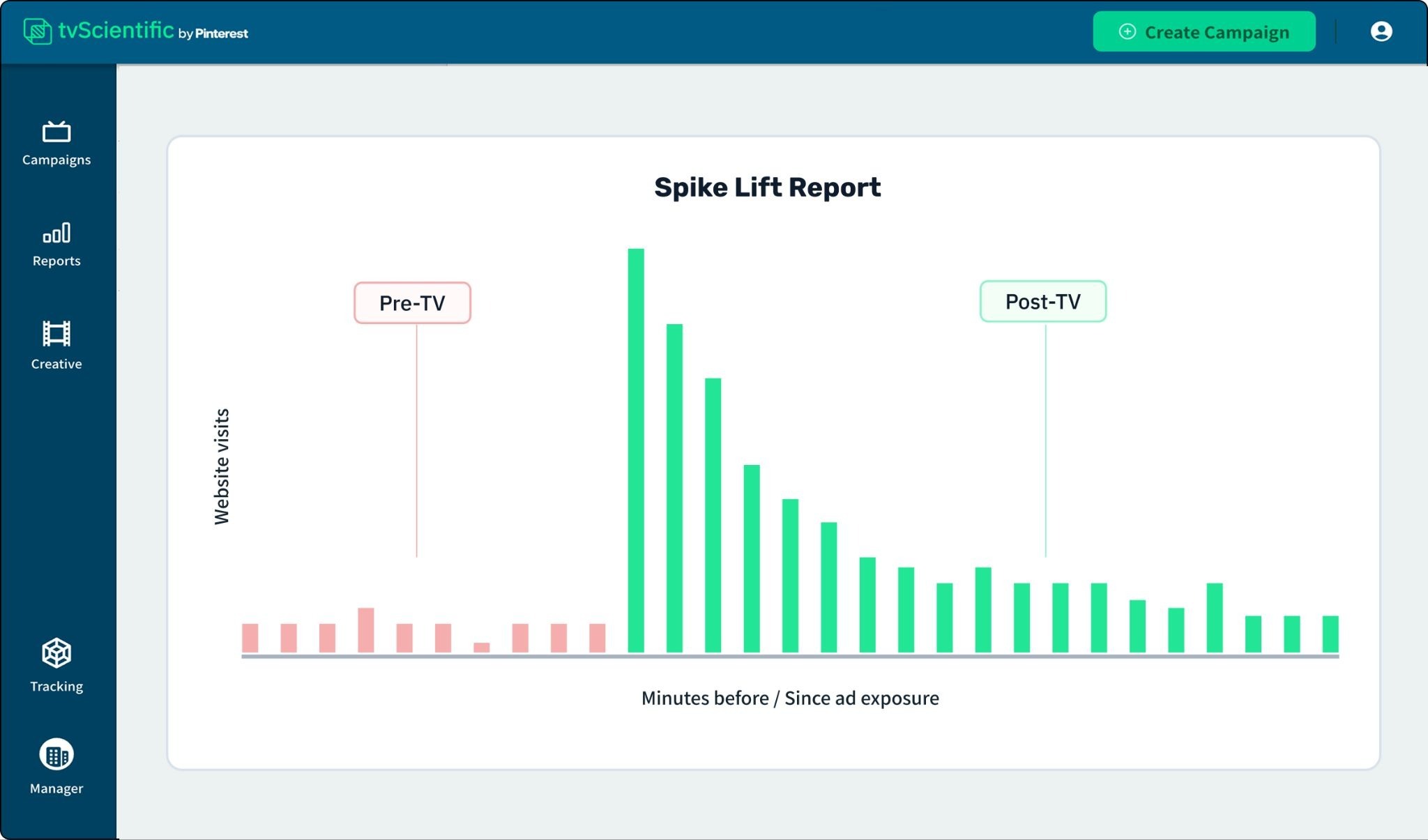
The simplest method was the one we ignored for years. We thought it wasn’t comprehensive enough since it didn’t connect the dots 1:1 between households that had been exposed to an ad to households that made a purchase. And it was almost too simple. It’s called spike lift analysis. Here's how it works: You plot website traffic or sales for an hour before a TV ad runs, and an hour after. Then you look at the spike. It's incredibly simple, and it demonstrates the irrefutable impact of TV advertising.
The litmus test
We need to stop celebrating the architects of confusion.
The next time someone presents a strategy, pitches a product, or hands you a five-page document that requires a glossary of terms to understand, push back. Challenge them to explain it simply. If they can't, send them back to the drawing board.
Complexity is easy. It’s time we started demanding the hard, agonizing, brilliant work of keeping things simple.
Inside Performance Advertising with Jason Fairchild delivers unfiltered insights, strategic perspective, and hard truths from inside the evolving world of adtech—cutting through the noise to focus on what really drives outcomes. Subscribe here.