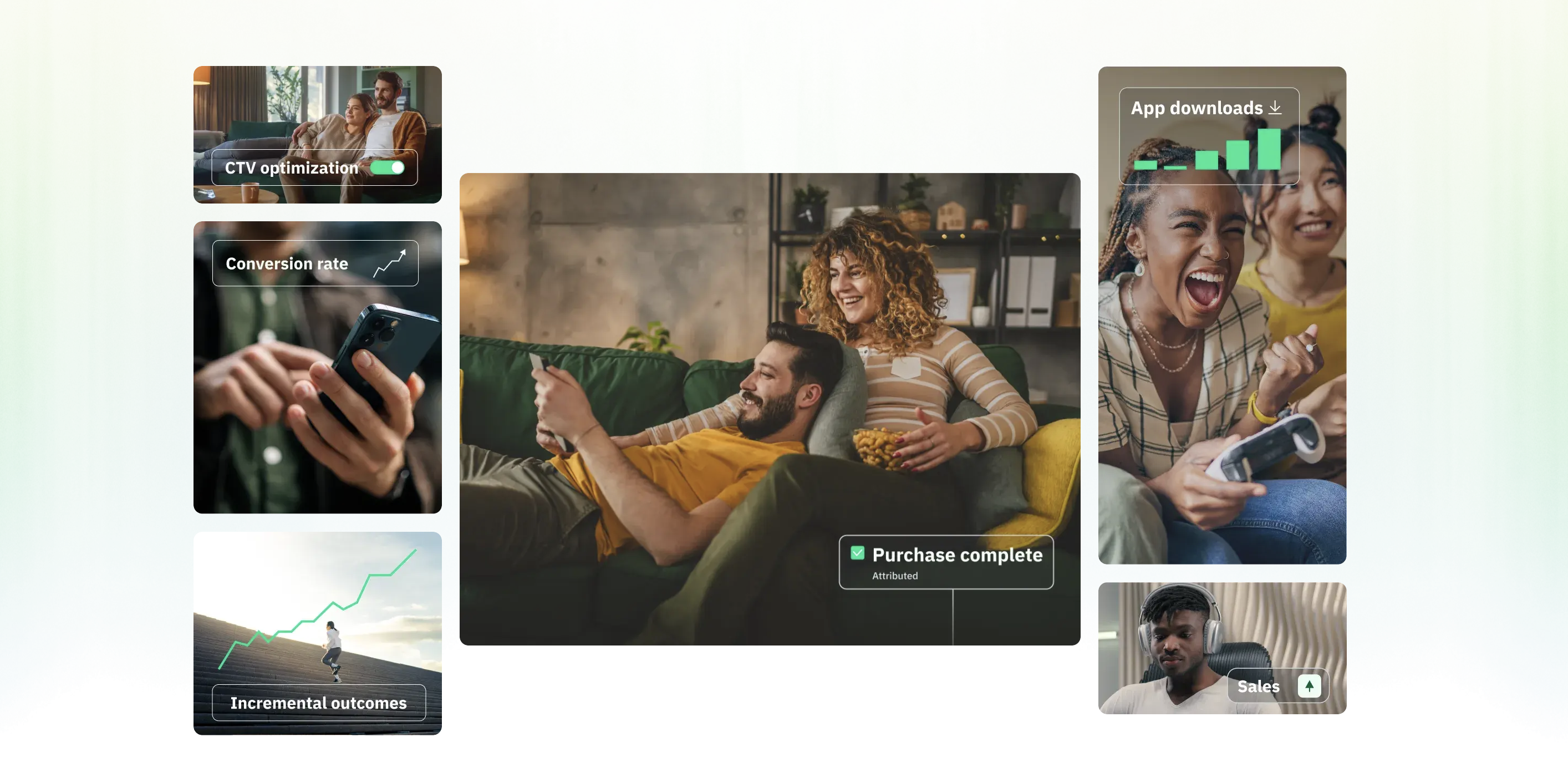
Picture a familiar planning conversation. Search is getting more expensive. Social is harder to break through. The team needs net-new growth, not another round of bidding harder for the same ready-to-buy customer. Then the question comes up: what role should TV play?
That is where Connected TV enters the conversation.
As streaming has become central to how people watch television, Connected TV has changed what TV can be for marketers. It combines the power of television with the targeting, optimization, and measurement modern teams expect.
This guide breaks down what Connected TV is, how Connected TV advertising works, and why it matters in 2026.
What is Connected TV?
Connected TV, or CTV, refers to television content streamed over the internet and viewed on a TV screen.
That includes content watched through:
- Smart TVs with built-in streaming apps
- Streaming devices connected to a television
- Gaming consoles connected to a television
- Live TV streaming services and ad-supported streaming platforms
From the viewer’s perspective, it still feels like watching TV.
From a marketer’s perspective, the difference is the infrastructure. Because the content is delivered digitally, Connected TV can support more precise audience targeting, more flexible buying, and stronger measurement than traditional linear TV alone.
Why Connected TV matters in 2026
Connected TV matters more in 2026 because both viewing behavior and marketing expectations have changed.
Streaming has become the center of modern TV consumption. Consumers now move fluidly across streaming, social, search, shopping, and direct visits. TV exposure often influences what happens next on other screens, not just what happens in the moment.
And that behavior is increasingly measurable. According to tvScientific by Pinterest’s 2026 Consumer Trends Report, 65% of consumers say they have made a purchase after seeing a TV ad, and 60% say they have searched for a brand after seeing one.1 The same report found that 78% scroll social media while watching TV, 69% browse online shopping, and 68% look up a product they saw in an ad while watching.1 That is what makes Connected TV so important now. It can create attention on the biggest screen in the home, then drive action across the rest of the media mix.
For marketers, that changes the role TV plays. It is no longer just about awareness. It can also support measurable outcomes such as sales, installs, site visits, subscriptions, and incrementality.
How Connected TV advertising works
Behind every Connected TV campaign is a system designed to make television more addressable and measurable.
1. Audience targeting
Most Connected TV targeting still relies on the same familiar inputs: past behavior, broad demographics, and purchase signals that appear after a decision is already underway. Those signals can still be useful, but they are often backward-looking.
With tvScientific by Pinterest, marketers can define audiences using a mix of:
- Pinterest’s high-intent or predictive signals that help identify people earlier in the decision-making process
- First-party data, such as CRM lists, site visitors, or app users
- Contextual signals, such as content type or time of day
- Modeled audiences based on historical performance
- Household and geographic signals
The goal is not just to find people who have already shown demand. It is to reach the audiences most likely to drive meaningful downstream action.
As Connected TV matures, audience strategy is becoming less about broad reach alone and more about signal quality. Better signals help marketers reach future customers earlier, optimize more effectively, and connect TV exposure to measurable business outcomes.
2. Programmatic buying
Much of Connected TV inventory is now bought programmatically across premium streaming publishers.
That allows marketers to:
- Launch campaigns faster
- Adjust budgets more easily
- Manage pacing and frequency
- Test audiences, creative, and inventory sources with more flexibility
Instead of treating TV as a fixed, upfront buy, marketers can manage Connected TV with more of the control they expect from digital channels.
3. AI-powered optimization
Modern Connected TV campaigns can optimize in near real time.
AI systems can evaluate signals such as:
- Audience performance
- Creative performance
- Time of day
- Device-level trends
- Inventory quality
- Conversion behavior
That makes it possible to allocate spend toward impressions that are more likely to drive the outcome that matters most, whether that is a purchase, app install, site visit, or another business KPI.
4. Cross-device attribution and incrementality
One of the biggest advances in Connected TV is measurement.
Exposure on the TV screen can now be linked to actions taken later on other devices in the same household. That helps marketers understand whether Connected TV drove a site visit, a search, a conversion, or broader lift across the media mix.
It also makes incrementality testing more important. Strong Connected TV measurement is not just about reporting what happened. It is about understanding what TV actually caused.
The key benefits of Connected TV advertising
For marketers, Connected TV combines advantages that used to live in separate channels.
Premium environments
Connected TV places ads inside professionally produced streaming content on the biggest screen in the home. That gives brands access to high-quality, brand-suitable environments.
Full-funnel impact
Connected TV can introduce a brand to new audiences, reinforce consideration, and influence conversion later through search, social, direct, or organic channels.
Measurable outcomes
Connected TV is increasingly evaluated on business outcomes, not just reach. That includes sales, revenue, installs, website traffic, and incrementality.
Stronger cross-channel performance
Connected TV often improves the efficiency of the rest of the media mix. A viewer may see a brand on TV, search for it later, and convert through another channel. With the right measurement, marketers can see that broader impact more clearly.
A more durable measurement foundation
Connected TV relies more on household and device-level infrastructure than on third-party browser cookies alone. In a privacy-first environment, that can provide a more durable foundation for targeting and measurement.
How Connected TV fits into the modern media mix
Connected TV works best when it is treated as part of a connected system, not as a silo.
Search is strong at capturing existing intent. Paid social can help create and capture demand. Connected TV adds something different: high-attention reach, immersive storytelling, and measurable influence earlier in the decision-making process.
That matters because consumers do not move through the funnel in a straight line. They discover in one place, evaluate in another, and convert somewhere else. If measurement only gives credit to the last touch, it misses the earlier moments that made the conversion more likely.
This is also where the halo effect matters. When Connected TV is measured correctly, marketers often see lift beyond the TV screen itself, including stronger branded search, better paid social and search performance, and more direct or organic traffic. That is why Connected TV is increasingly being used as both a demand-creation and performance channel.
The next step for Connected TV in 2026
As Connected TV matures, the opportunity is no longer just to buy streaming inventory more efficiently. It is to pair better signals with better optimization and clearer measurement.
That is part of what makes tvScientific by Pinterest so powerful. By combining Pinterest’s predictive intent signal with tvScientific’s Performance TV engine, advertisers can reach future customers earlier, optimize toward real business outcomes, and prove TV’s impact across the funnel.
It is a subtle but important shift. In a crowded market, the next advantage often comes from identifying intent earlier, influencing decisions while they are still taking shape, and measuring the full effect of that influence across channels.
Frequently Asked Questions about Connected TV
What is Connected TV advertising?
Connected TV advertising refers to serving video ads within streaming content viewed on an internet-connected television. It combines the visual impact of TV with digital-style targeting and measurement.
What is the difference between Connected TV and OTT?
OTT refers broadly to video delivered over the internet, regardless of device. Connected TV refers specifically to OTT content watched on a television screen.
Is Connected TV good for performance marketing?
Connected TV can be a strong part of a performance strategy when campaigns are built around clear goals, strong creative, AI-assisted optimization, and robust measurement. Results vary by brand, audience, and budget, so structured testing is important.
Is Connected TV only for large enterprise brands?
No. Programmatic access and flexible buying models have made Connected TV more accessible to a wider range of advertisers.
Want to see how Performance TV can drive more measurable growth for your brand? Book a demo with tvScientific.
Sources:
1. tvScientific by Pinterest, 2026 Consumer Trends Report, United States, April 2026.